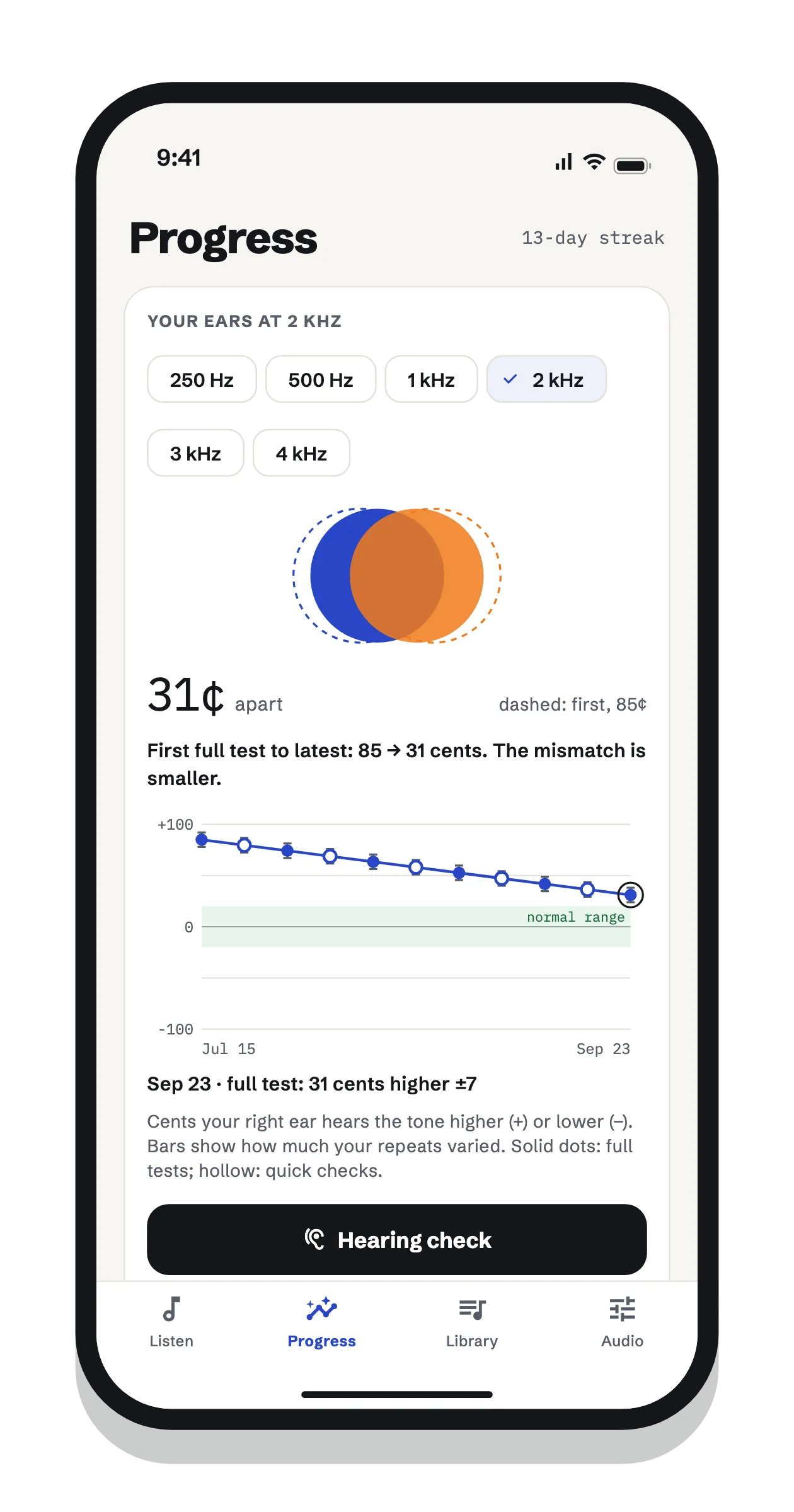
Harmonic Recovery rests on a few findings about how adult hearing adapts. Here is each one, what it suggests, and the honest limits: no study has yet tested this method for diplacusis.
By the developer of Harmonic Recovery, who has diplacusis · not a clinician · Last reviewed September 25, 2026
The idea in one paragraph
If one ear hears pitch wrongly and the other hears it correctly, perhaps the correct ear can
act as a reference that the brain uses to recalibrate the other. Harmonic Recovery plays your
music clearly in the affected ear while the same music fades in and out in your other ear as
a pitch hint. The hint gives the correct pitch to compare against, then steps
back so the affected ear has to hold it on its own. Over time, the training levels make the
hint rarer.
Why it might work
Adult pitch perception can recalibrate
The strongest evidence comes from cochlear implants. The pitch an implant electrode produces
often doesn't match what the listener expects at first. Studies that followed implant users
found the heard pitch shifted over months and years, in some cases by two octaves or more. In
users with some natural hearing, it shifted toward the pitch their natural hearing
reported: the brain seems to recalibrate one input against a trusted reference.
Pitch hearing improves with practice
People's ability to tell close pitches apart improves measurably with practice, a well-studied
kind of "perceptual learning". Active practice with feedback, such as saying whether a tone
was higher or lower and being told the answer, generally trains better than passive
listening. That's why the app includes short drills as well as music.
Vision offers a parallel, and a warning
Some treatments for amblyopia ("lazy eye") turn down the strong eye's input so the brain has
to rely on the weak eye. It's the same shape of idea. But it's also a warning: in a large
randomized trial, a binocular iPad game built on this idea did worse than ordinary patching.
Plausible mechanisms don't guarantee results.
Why it might not
It hasn't been tested. No published study has tested a pitch hint, or any
home practice method, for diplacusis.
The brain might simply defer to the good ear while the hint plays, without
retraining the affected ear at all.
The brain might learn to tolerate the mismatch rather than fix it. People
with hearing loss can merge tones from the two ears into one sound even when they're far
apart in pitch. Practice could strengthen that merging instead of correcting the pitch.
Diplacusis often changes on its own, as the underlying hearing loss
recovers or fluctuates. Without a comparison group, it's impossible to say whether any
change came from practice.
So why measure?
Because the method is unproven, the app doesn't assume it works for you. It measures:
A listening setup for each pair of headphones finds each ear's quietest
audible level. It's a short version of the clinical method, with silent catch trials, so
tones play at a level suited to each ear and measurements stay comparable.
The hearing check matches loudness first, since pitch shifts with loudness
in affected ears. It then pitch-matches at six frequencies, twice each, playing the ears one
after the other so the brain can't merge the tones.
Changes are only called real when they're bigger than your own variation
between repeated answers. Otherwise the app says "no clear change".
Drills adapt with a standard staircase method, settling where you're right
about 71% of the time.
The result is an honest answer to the only question that matters to you: is your
mismatch changing? Your measurements stay on your phone.
What would change our minds
If users' measurements show no change beyond normal variation after weeks of practice, that's
evidence against the method, and we'd say so. We'd welcome working with researchers on a
proper study. If you're an audiologist or hearing researcher, get in touch.
This page summarizes published research and public health sources for general
information. It is not medical advice. An ENT or audiologist can examine your ears and
tell you what applies to you.
Harmonic Recovery
Measure it properly, and practice with your own music
A headphone setup tuned to each of your ears, a pitch-matching check at six frequencies,
a pitch hint that plays in your other ear while you listen to your own songs, 3-minute
drills, and a chart that shows whether anything is changing. Free to start.
On a computer? Scan with your phone's camera to open the app in its store.