About
Why I built Harmonic Recovery
I have diplacusis. I built Harmonic Recovery so I could practice with music and measure
whether anything changes, and so others with it could too.
What I set out to make
The app does two things:
-
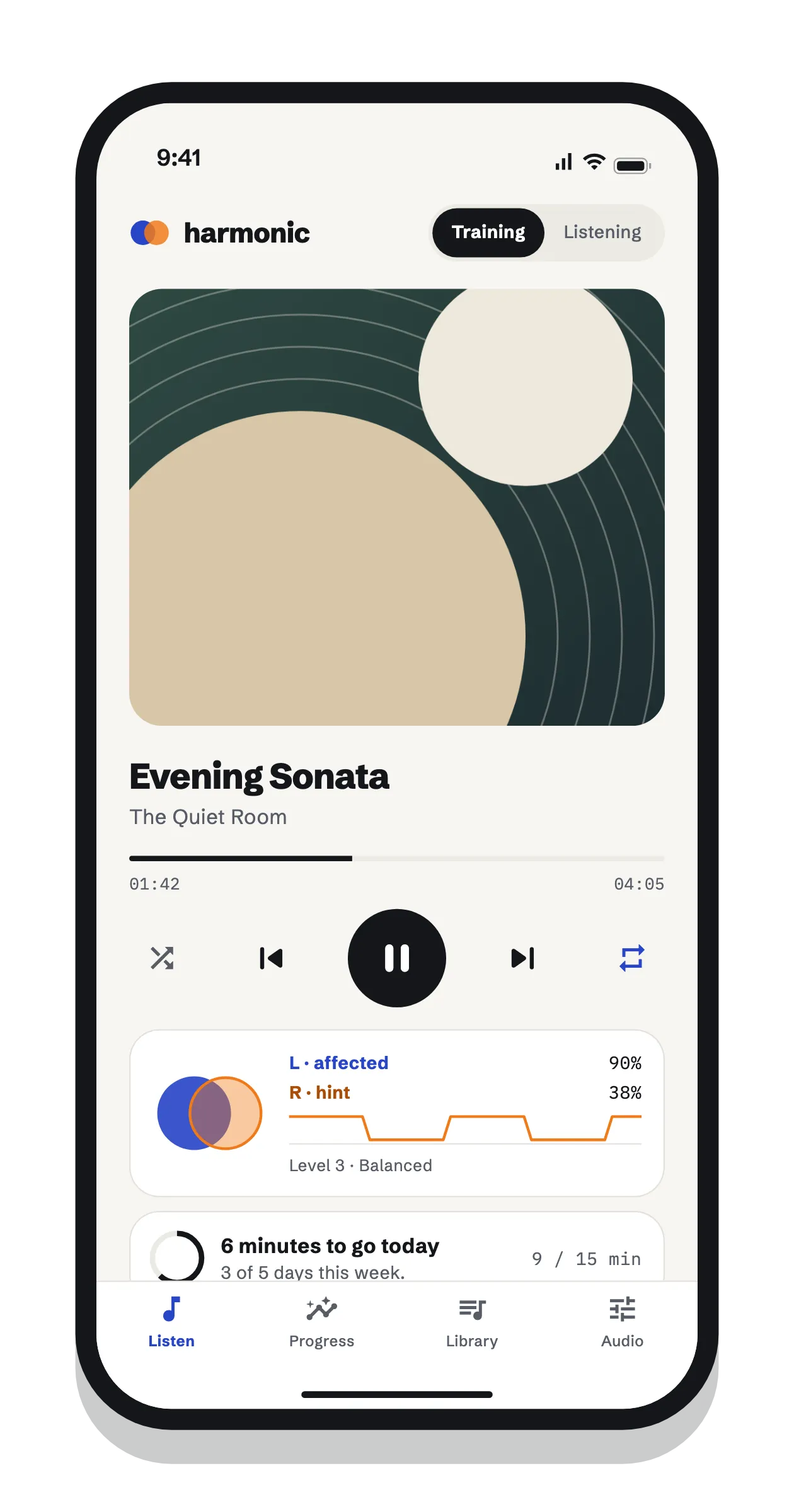
Practice with music. Your own songs play clearly in the affected ear
while the same music fades in and out in the other ear, a reference for the right pitch.
It's based on research showing adult pitch hearing can recalibrate against a trusted
reference.
-
Honest measurement. A careful pitch-matching check, repeated over time,
so you can see for yourself whether your mismatch is changing.
What I promise, and what I don't
-
It isn't a treatment. No study has tested this method for diplacusis
yet. Here's the research and its limits.
-
It won't overclaim. The app only calls a change real when it's bigger
than your own normal variation.
-
Your results stay on your phone. No account, no ads.
Details.
-
Nothing is deleted if you stop paying. Measurement stays free, because
everyone deserves to know whether their hearing is changing.
Who's behind it
Harmonic Recovery is made by Tinibo LLC, a small independent developer. I'm not a doctor or
audiologist. The health pages on this site summarize published research and public health
sources, cited on each page and dated with when they were last reviewed. If you're a clinician or researcher
and see something to correct, or would like to study whether this kind of practice helps,
I'd love to hear from you.
Harmonic Recovery
Try it for yourself
A headphone setup tuned to each of your ears, a pitch-matching check at six frequencies,
a pitch hint that plays in your other ear while you listen to your own songs, 3-minute
drills, and a chart that shows whether anything is changing. Free to start.
On a computer? Scan with your phone's camera to open the app in its store.