What is diplacusis?
Diplacusis (dip-luh-KOO-sis) means hearing one sound at two different pitches. It comes in
two forms:
-
Binaural diplacusis, the common one: the same tone sounds like a different
pitch in your left ear than in your right. Play a note to one ear, then the other, and they
don't match.
-
Monaural diplacusis: a single tone, heard in one ear, sounds like two
pitches at once, or rough and buzzy.
Some hearing-clinic websites say "monaural" means hearing loss in one ear and "binaural" in
both. That's a mix-up: the words describe how the pitch is heard, not which ears have hearing
loss. This site is mostly about binaural diplacusis.
What does it sound like?
Diplacusis is often much more obvious with music than with speech, because music depends on
exact pitch. People describe it as:
- music sounding out of tune or sour, as if the band were slightly detuned
- a chorus or doubled sound, like two instruments playing almost the same note
- a singer who seems flat or sharp, even on a recording you know is in tune
- held notes, such as a piano chord or a sustained vocal, that wobble or clash
- one ear that seems to hear everything a little higher than the other
When both ears hear the same sound, the brain has to combine two slightly different pitches.
Sometimes it merges them into one; sometimes you hear the clash. In one study, people with
hearing loss merged tones from the two ears that were far further apart in pitch than people
with normal hearing did: on average about 1.7 octaves, against 0.17 octaves.
That may be why the effect can come and go, and why it's often easiest to notice by covering
one ear, or with earphones.
How big is the difference?
Pitch differences are measured in cents: 100 cents make one semitone, the
step between two neighboring piano keys, and 1,200 cents make an octave. Trained listeners
with normal hearing can tell apart tones only a few cents apart, and untrained listeners need
more. Small differences between the ears are normal, and repeated matches vary by several
cents even in healthy hearing, which is why a single reading means little.
Diplacusis ranges from subtle to large. In a 2016 study of 43 adults with hearing loss, about
two thirds had a clear pitch difference between their ears at the edge of their hearing loss,
and about half had a difference bigger than any normal-hearing listener in the study showed:
more than about a semitone. The worse-hearing ear usually heard the higher pitch.
What causes it?
Your inner ear (the cochlea) sorts sound by pitch: each frequency makes a particular spot along
it vibrate most, and the brain reads pitch partly from where that happens. When the
inner ear is damaged or swollen with fluid, that map can shift, so the same note excites a
slightly different spot and sounds like a different pitch. If only one ear is affected, the
two ears disagree.
Diplacusis has been documented with:
-
Inner-ear (sensorineural) hearing loss, especially when one ear is worse
than the other. Pitch in damaged ears can also shift with loudness more than normal.
-
Ménière's disease, an inner-ear disorder with vertigo, hearing loss,
tinnitus and a full feeling in the ear, usually in one ear. Researchers estimate at least
half of people with Ménière's have diplacusis, linked to fluid build-up in the inner ear
(endolymphatic hydrops).
-
Sudden sensorineural hearing loss, where hearing drops in one ear over
hours or days. Diplacusis has been measured during an episode and seen to settle as the
hearing recovered. More on pitch after sudden hearing loss.
-
Noise exposure and professional music-making. Two studies of professional
musicians found diplacusis in about 6% of the 380 players assessed.
Diplacusis for musicians.
Other conditions that cause hearing loss in one ear, such as a vestibular schwannoma
(acoustic neuroma, a benign growth on the hearing and balance nerve), are worth a doctor
ruling out, because one-sided hearing changes are a reason to be checked. Diplacusis itself
doesn't tell you the cause.
How is diplacusis measured?
A standard hearing test (an audiogram) measures how quiet a sound you can hear at each
frequency. It doesn't measure what pitch you hear, so a normal-looking audiogram
doesn't rule out diplacusis.
Diplacusis is measured by pitch matching: a tone plays in one ear, then a
tone in the other, and you adjust the second until the two sound like the same pitch. The
difference between where you set it and where it should be, in cents, is your pitch mismatch.
Good measurements:
- play the ears one after the other, never together, so the brain can't merge the tones
- match loudness first, because pitch shifts with loudness, especially in affected ears
- test several frequencies, since the mismatch is often largest in one range
- repeat each match, to separate a real difference from ordinary variation
You can get a rough first reading with our free online pitch check.
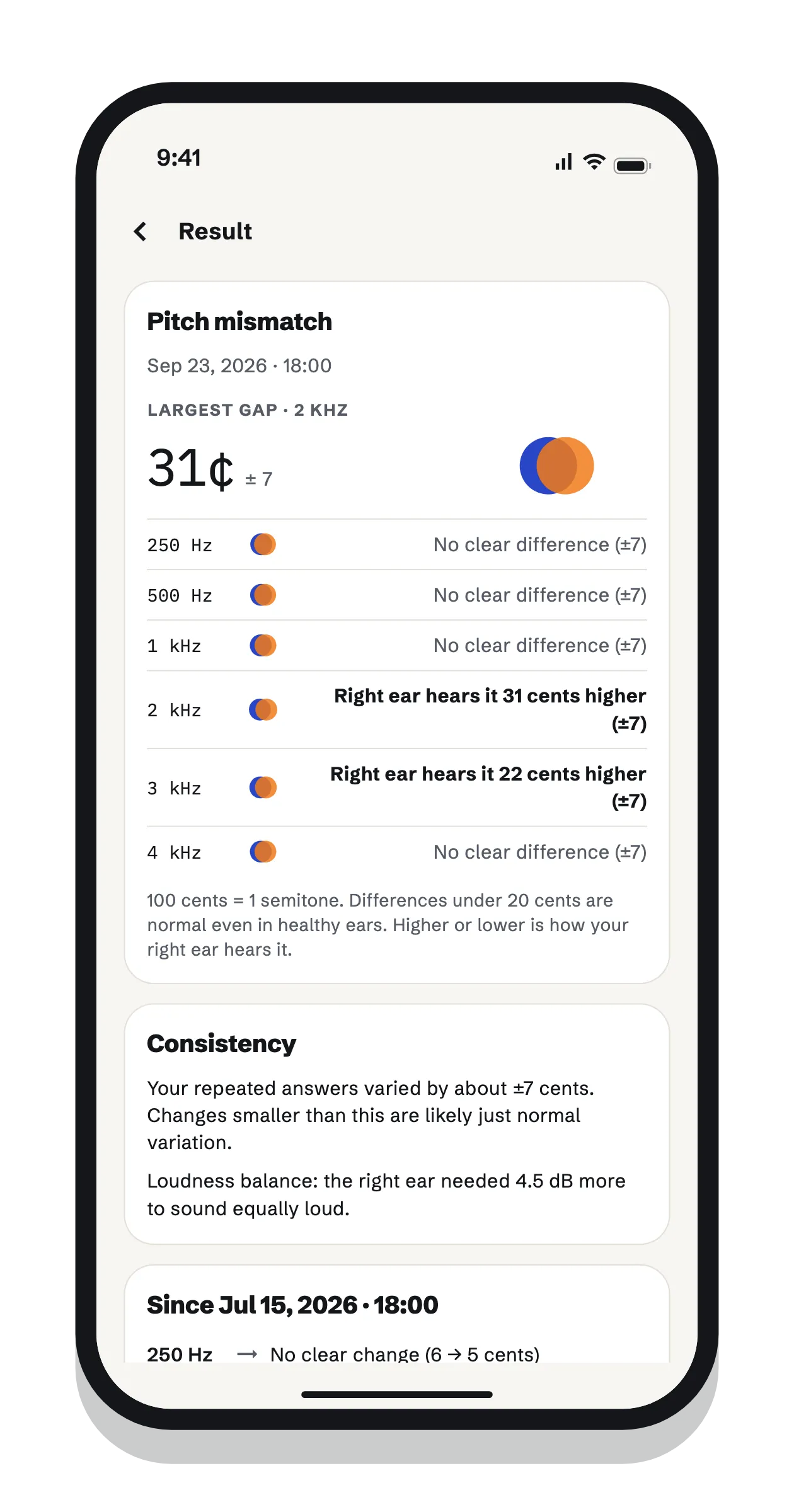
The Harmonic Recovery app does the full version: a setup for your headphones, a loudness
match, six frequencies with repeats, and a chart over time.
When should I see a doctor?
Always get new pitch changes checked, especially if they come with hearing loss, ringing,
a blocked or full feeling, or dizziness. Get urgent help for:
- sudden hearing loss in one or both ears, over hours or a few days
- hearing that has got worse over days or weeks
- hearing loss with earache or discharge
- hearing loss with a drooping face, numbness or other stroke-like signs (go to an emergency department)
An ENT (ear, nose and throat) doctor or an audiologist can test your hearing, look for the
cause, and treat what's treatable. With sudden hearing loss, time matters: steroid treatment
works best when it starts early, ideally within two weeks.
Does diplacusis go away?
Sometimes. When the hearing loss behind it recovers, as it can after sudden hearing loss, the
diplacusis can settle too. Researchers also expect the brain to adapt to a lasting mismatch
over time, and people with cochlear implants show that adult pitch perception can shift
toward the other ear. But there are no large studies of how diplacusis changes over time.
Read more about whether diplacusis goes away.
Is there a treatment?
There's no proven treatment for diplacusis itself. What doctors treat is the cause: for
example, sudden hearing loss is treated with steroids, and Ménière's disease with diet
changes, medicines and other measures. Treating the cause can reduce the diplacusis.
Harmonic Recovery is a practice and measurement tool built on a simple idea: let the ear that
hears correctly act as a reference while you listen to music. It is not a
treatment, and no study has tested whether this kind of practice reduces
diplacusis. What it does do is measure your mismatch the same way each time, so you can see
for yourself whether it's changing. Read about the research behind it.
Living with diplacusis
-
Protect your hearing. Keep music at moderate volume and use hearing
protection around loud noise, so your hearing doesn't get worse.
-
Keep a record. Diplacusis can fluctuate, especially with Ménière's. Notes on
how music sounds each day, and measurements made the same way each time, make it easier to
see a trend and to describe it to your doctor.
-
You're not imagining it. Many people spend a long time before they learn
the word for what they hear. It's a real, measurable difference in how the two ears hear
pitch.